
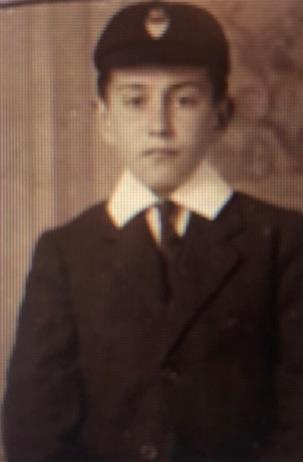
Cecil was born in Southampton, on 13th January 1886, the second child of Edwin CHRISTMAS born in Alton and Margaret Abigail CHRISTMAS (née Russell) who was born in Portchester. On his Cecil’s birth certificate, his names are recorded as Edwin Vincent Russell CHRISTMAS, but when he was baptised at St Mary’s Church, Portchester on 22nd September 1886, the second name was amended to Cecil. He had 8 siblings; 5 brothers and 3 sisters although 1 died in infancy.
Cecil was educated as a boarder (1901 census) at Banister Court School, Banister Road, Southampton. The school was initially set up in 1867 for the sons of Peninsular Steam Navigation Company officers by the Reverend George Ellaby. Amongst its former pupils was a certain Charles Miller.

During Cecil’s time at the school, the headmaster was a Christopher George Ellaby, the son of the founder. Cecil was a very keen sportsman, and in July 1899, he & his partner, W. MacDonald beat P Keene and T Persee in the Doubles Fives Competition Final (Hants Advertiser, Aug 12 1899 p6/8) Two years later, he reached the senior singles final but was defeated in a close fought match with P. Keene.
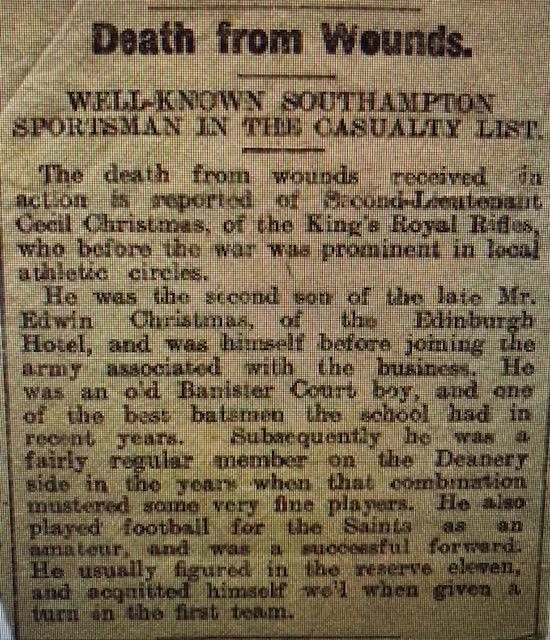
In the December 1900 and 1901 Hampshire Advertiser it was reported of various successes Cecil had on various sporting activities. Cecil was also a good cricketer “one of the best batsmen the school had in recent years” and footballer.
Cecil’s father, Edwin CHRISTMAS, died on 21st January 1911 leaving an estate of £14,117. Cecil and his elder brother, William Foster CHRISTMAS, took over the licence of the Edinburgh Hotel, 1 St Marys Road, Southampton. In the 1911 census, Cecil, then aged 23, was resident at the hotel, with his 20-year-old brother, Harold, their 11-year-old sister, Marjorie and a 29-year-old cousin, Margaret Christmas, who acted as housekeeper, along with three live-in members of staff.


The Edinburgh Hotel stood at the junction of St. Mary’s Road and St Andrew’s Road at the Six Dials junction. The pub’s licence was placed in suspense on 20 February 1963. The building was then acquired by the local authorities under a compulsory purchase order and was demolished shortly afterwards. The Six Dials car park later occupied the site, which is now lost completely within the Six Dials traffic system. It belonged to Brickwood’s Brewery when it closed for good in 1963.
Football Career
Cecil first played for Southampton Football Club as an amateur in the 1908–09 season when he signed on Hampshire League forms, he made several appearances for the reserve team but left in 1910 to focus on his involvement in the family hotel business.


Cecil was persuaded to return to the club by reserve team manager George Carter for the 1911/12 season, this time on Southern League forms, as the club had recently suspended their two regular forwards, Henry Hamilton and Andrew Gibson, for serious breaches of club discipline.
Cecil was drafted into action with the first-team, making his debut away to Crystal Palace on 16th March, which ended in a 3–1 defeat. A week later at The Dell he played his second game against Luton Town, his “pace and dribbling skills” helped his side to a 3–1 victory. Unfortunately, a serious injury prevented Cecil from finishing the match. The club retained his services for the following season however he made no further first-team appearances, and his football career was over.
Masonic
Cecil, occupation of Hotel Proprietor, followed his brother William into Southampton’s Lodge of Peace and Harmony No 359. He was initiated on 18th January 1915 alongside a 35-year-old builder, Walter Brazier of Braziers and Sons. Both men were passed to the second degree on 15th February 1915. Walter Brazier was raised to the third degree in April 1919, but Cecil’s raising was delayed, and he became a Master Mason on 21st June 1915.
Military Service

On 30th June 1915, Cecil enlisted at Dukes Road in Bloomsbury, London, joining the 1/28th (County of London) Battalion (Artists Rifles), London Regiment as Private No.R/4150.
The Artists Rifles had been originally founded in 1859 as a volunteer regiment, but in 1908 became part of the London Regiment as the 28th Battalion. Early in 1915, a separate Officer Training Corps had been established, to which Cecil was transferred. The Corps trained at Hare Hall in Gidea Park, in East London.
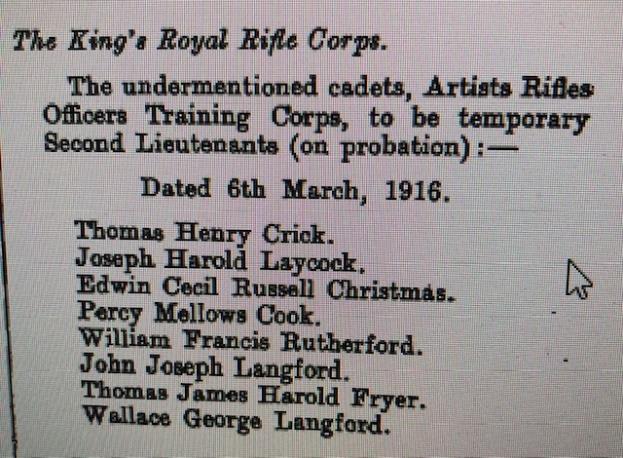
On 6 March 1916, Cadet Cecil CHRISTMAS was commissioned as a Second Lieutenant into the 18th (Service) Battalion (Arts & Crafts) King’s Royal Rifle Corps (KRRC), with his promotion being maderetrospective to 20th December 1915. His character reference was supplied by his former headteacher at Banister Court School, Mr Christopher Ellaby.
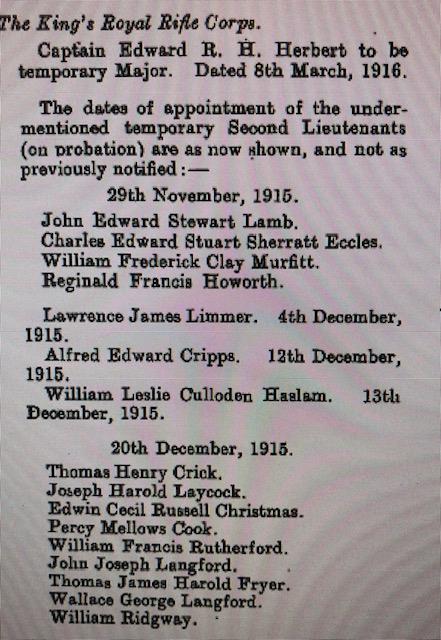
The 18th (Arts and Crafts) Battalion, Kings Royal Rifle Corps was raised at Gidea Park on 4 June 1915 by Major Sir Herbert Raphael. After initial training close to home, the battalion joined the 122nd Brigade, 41st Division at Witley, near Guildford, in October. In November, they moved to Aldershot, in February to Witley before returning to Aldershot for final training.
They proceeded to France, sailing from Southampton on the evening of 2nd May 1916, landing the following morning at Le Havre, from where they travelled by train to Godewaersvelde, a few kilometres from the Belgian border. After a few days in billets at Moolenaker, 8 km south, the battalion moved to Steentje, 4 km south of Bailleul.

On 30th May, the battalion had their first experience of the front line when they took over a section of the trenches at Ploegsteert Wood, just across the border in Belgium.
This had been the scene of fierce fighting in the early part of the war, but by 1916 it was considered to be a ‘quiet’ sector, and at first the battalion had little engagement with the enemy with few casualties, although on 10/11 June, three men were killed when the trenches came under bombardment.
On 25th June, two officers and a company sergeant major were killed when a number of rifle grenades landed in the front-line trenches. On 30th June, the battalion launched a raid on the enemy lines supported by artillery bombardment, to which the Germans retaliated in kind resulting in the deaths of seven men from the 18th KRRC, with several more wounded.
The battalion remained in the front line until 28th July, when they withdrew to billets at Papot to the north-west of Nieppe. This was only a brief respite and on 3rd August the battalion returned to the trenches north of Ploegsteert Wood, where they remained until relieved on 9th August with no serious casualties. After a week in billets at Papot, they were then withdrawn from the front line and marched to Bailleul (14 km west).
On 24th August, they travelled by train to Abbeville (110 km south west), from where they marched to billets at Brucamps (17 km east). After two weeks training at Brucamps, the battalion was moved 55 km east to Fricourt, where they returned to the trenches on 14th September. The following day, the battalion took part in an assault on the village of Flers; although the battalion secured their objectives, this came at a very heavy cost.
The Battle of Flers – Courcelette was the first in which the allied forces used tanks in battle. Although the British succeeded in capturing the two villages, casualties were high with nearly 30,000 men killed between 15th and 22nd September 1916.
On 19th September, the battalion were withdrawn to billets at Dernancourt, near Albert, 18 km behind the front line, where they remained until 2nd October. On 2nd and 3rd October, the battalion marched eastwards in heavy rain, reaching the trenches north of Delville Wood, 5 km south of Flers, at 10 pm on 3 October.
On the evening of 4th October, the battalion supported the 11th Battalion Royal West Kent Regiment and the 15th Battalion Hampshire Regiment in an attack on the enemy defences in front of the village of Le Sars. Although the battalion war diary describes this as “entirely successful”, the battalion incurred heavy casualties, with 100 men killed.
On 7th October 1916, the battalion re-launched the attack on the German lines south of Le Sars in support of the 11th Royal West Kent and 15th Hampshire Regiments, the Battle of the Transloy Ridges. The war diary reports the events of the next two days:
“The attack commenced quite successfully, zero hour being 1:45pm. The battalion was held up by machine gun fire. At dusk, a new line was dug two hundred yards in front of original front line. The Flers Road was heavily shelled on the 7th and our transport had casualties of four drivers and several horses killed.”
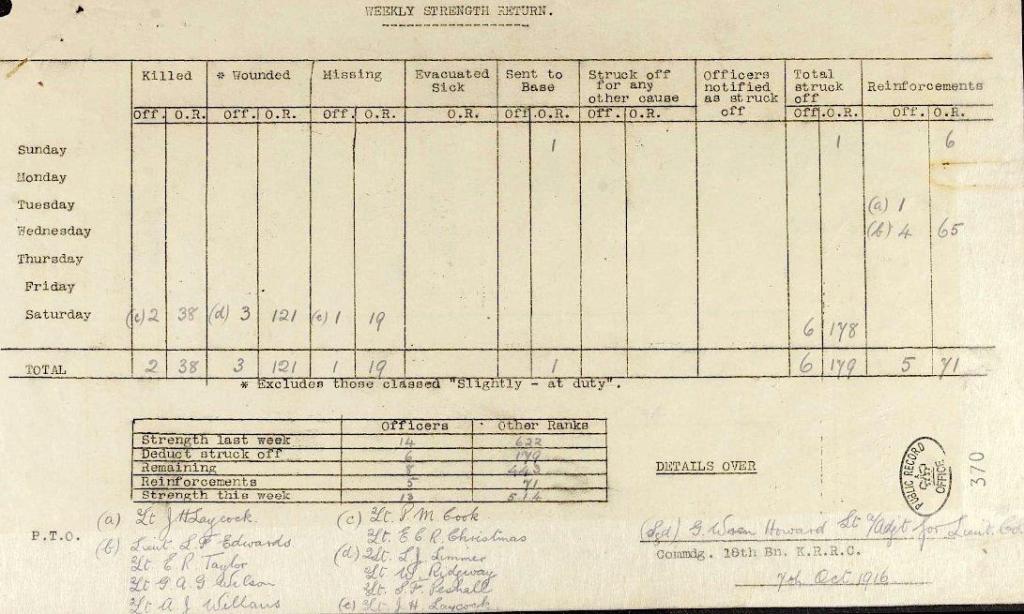
The CWGC recorded 65 men killed from the 18th Kings Royal Rifles Corp between 2nd and 10th October 1916 including 2nd Lieutenant ECR CHRISTMAS who is recorded as dying from wounds during the Battle of the Somme, Northern France.
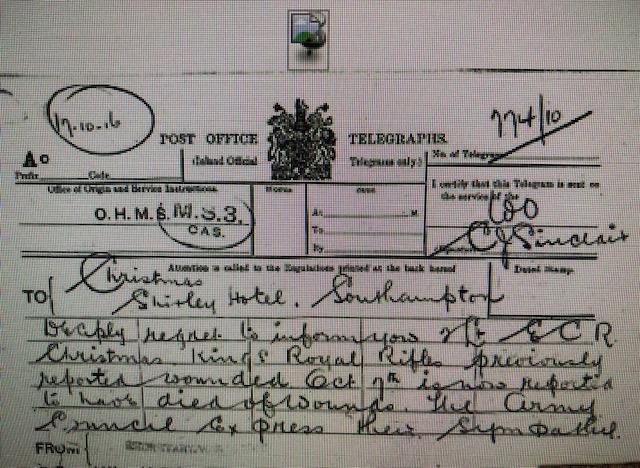
On 12th October 1916, Cecil’s brother William (now the licensee at the Shirley Hotel, Southampton) received a telegram reporting that Cecil had been wounded on 7th October.
Sadly, this was followed by a second telegram received on the 17th October:
“Deeply regret to inform you that 2nd Lieutenant ECR CHRISTMAS, Kings Royal Rifles, previously reported wounded October 7th is now reported to have died of wounds. The Army Council express their sympathy”.
Cecil was just 30 years old.
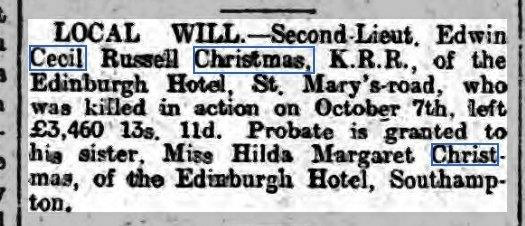


Cecil’s sister, Hilda Margaret CHRISTMAS, was appointed as administrator of his estate, which was valued at £3,460 & 13s 11d. A large sum of money for that time.
At the time of his death, Cecil was still the licensee at the Edinburgh Hotel. On 15 January 1917, the licence was formally transferred to his brother, William.

In September 1919 Villas, Cottages and Market Garden Land in Portchester was at sale at Auction – property belonging to Edwin CHRISTMAS.
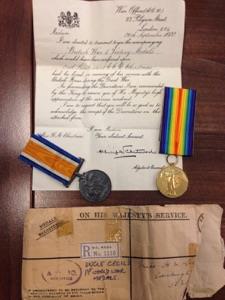
For his service, Cecil was posthumously awarded the British War Medal and Victory Medal. Cecil had served for 7 months; his body never recovered from the battlefield. He is one of over 72,000 men from Britain and South Africa commemorated on the Thiepval near Picardy in France to the Missing of the Somme.

He is also commemorated on the Cenotaph in Southampton’s Watts (West) Park and on a memorial at St Mary’s Church, Portchester. In the Masonic Roll of Honour and his name is also recorded in the Kings Royal Rifles Corp Memorial Book, kept at Winchester Cathedral.

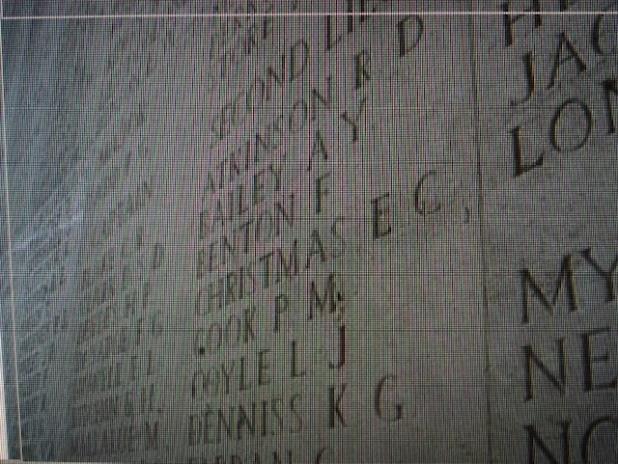


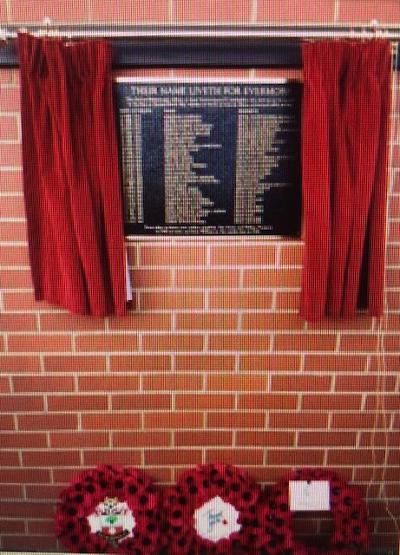
In November 2018, a memorial was unveiled at St Mary’s Stadium, Southampton for former Southampton FC players killed in the two World Wars, on which Cecil’s name is recorded.
For a man so young he achieved a lot in his short life; from being a multi skilled sportsman to running his own hotel by the age of 25. A Master Mason. A brave soldier who after 6 months had gained promotion to 2nd Lieutenant and served his country on the battle fields of the Somme. Rest in Peace Mr Christmas.
Sources
Provided on request via our contacts page.



 Saints Archive
Leave a reply to John Holiday Cancel reply