
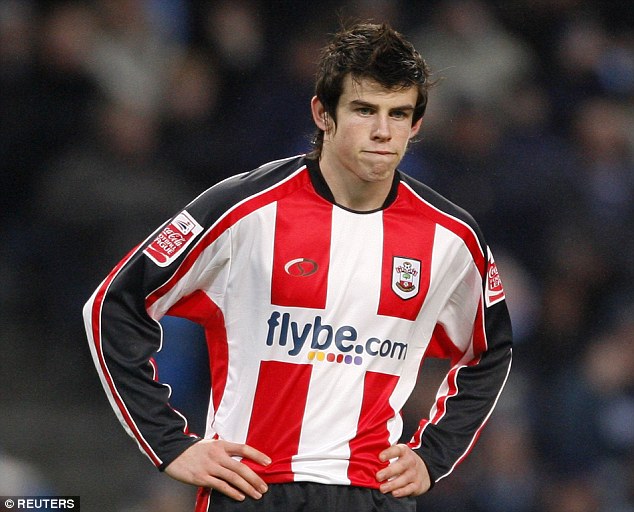
Gareth Bale is widely regarded as one of the best players of his generation, having won multiple trophies with Real Madrid. But before he became a household name, he was a promising youngster who started his career at Southampton.
Early days at Southampton
Bale was born in Cardiff, Wales, on 16th July 1989. He showed a natural talent for football from an early age, and joined Cardiff Civil Service as a junior player. He was spotted by Southampton scout Rod Ruddick, who invited him to a trial at the age of nine. Bale impressed the coaches with his skill, speed, and versatility, and was offered a place at the Southampton Academy.
Bale progressed through the youth ranks at Southampton, and made his debut for the senior team on 17 April 2006, at the age of 16 years and 275 days. He came on as a substitute in a 2–0 win over Millwall in the Championship, becoming the second-youngest player ever to play for Southampton, after Theo Walcott.
Bale soon established himself as a regular starter for Southampton, playing as a left-back. He scored his first goal for the club on 6 August 2006, in a 2–2 draw against Derby County, with a free kick from 30 yards out. He scored four more goals in his first season, all from free kicks, and was named the Football League Young Player of the Year.
Bale continued to impress in his second season, scoring another five goals and attracting interest from several Premier League clubs. He also made his debut for the Wales senior team on 27 May 2007, becoming the youngest player ever to represent Wales, at the age of 16 years and 315 days.
Transfer to Tottenham Hotspur
On 25 May 2007, Bale signed for Tottenham Hotspur for an initial fee of £5 million, with a potential rise to £10 million depending on his appearances. He agreed a four-year contract with the London club, and was given the number 16 shirt.
Bale made his Tottenham debut on 26 August 2007, in a 1–0 win over Manchester United at Old Trafford. He scored his first goal for the club on 1 September 2007, in a 3–3 draw against Fulham, with a header from a corner. He scored two more goals in his first season, against Arsenal and Middlesbrough, but also suffered a serious ankle injury that ruled him out for the rest of the campaign.
Bale struggled to regain his form and fitness in his second season, and was often sidelined by injuries and competition from Benoît Assou-Ekotto. He failed to win a single league game in his first 24 appearances for Tottenham, a run that spanned two seasons and ended on 26 September 2009, when he came on as a substitute in a 5–0 win over Burnley.
Bale’s fortunes changed in his third season, when he was moved to a more advanced role as a left winger by manager Harry Redknapp. He scored his first league goal in almost two years on 26 December 2009, in a 2–0 win over Fulham, and went on to score seven more goals in the season, including a hat-trick against Inter Milan in the Champions League. He was named the PFA Young Player of the Year and the FWA Footballer of the Year for his performances.
Bale continued to excel in his fourth season, scoring 13 goals and providing 17 assists in all competitions. He scored memorable goals against Arsenal, Chelsea, and Norwich City, and was named in the PFA Team of the Year for the second consecutive season. He also signed a new four-year contract with Tottenham, keeping him at the club until 2016.
Bale had his best season yet in his fifth and final season at Tottenham, scoring 26 goals and providing 15 assists in all competitions. He scored stunning goals against West Ham United, Southampton, and Sunderland, and won several individual awards, including the PFA Players’ Player of the Year, the PFA Young Player of the Year, the FWA Footballer of the Year, and the Premier League Player of the Season. He also became the first player to win all three major awards in the same season since Cristiano Ronaldo in 2007.
Stats
Bale made a total of 40 appearances for Southampton in the Championship, scoring five goals and providing 11 assists. He also made one appearance in the Championship play-offs, but could not prevent Southampton from losing to Derby County in the semi-finals.


 Saints Archive
Leave a comment